


Most animals that encounter a mirror treat it as another animal. They posture at it, vocalize at it, or lose interest when the reflection fails to respond the way a real companion would. Only a handful of species respond differently, investigating the reflection as a representation of themselves rather than as another individual. Dolphins are among them.
The mirror self-recognition test is one of the most widely used measures of self-awareness in animals, and what dolphins do when placed in front of one tells researchers something significant about the kind of minds they are working with.
What the mirror test actually involves
The mirror self-recognition test was developed in 1970 by psychologist Gordon Gallup Jr. and has since been applied to dozens of species. The basic procedure involves three stages.
First, the animal is given time to explore the mirror with no marks on its body. This establishes a baseline for how it interacts with its own reflection. Second, while the animal is anesthetized or otherwise unaware, a visible mark is placed on its body in a location it cannot see directly without a mirror. Third, the animal is returned to the mirror and observed. If it uses the reflection to investigate or touch the mark on its own body, rather than treating the reflection as another animal, this indicates self-recognition.
The test is demanding because it requires the animal to understand, at some level, that the image in the mirror is of itself. This is not a behavior that can be trained or shaped by reward. It requires a pre-existing concept of self as a distinct entity in the world.
How dolphins respond to their own reflection
In studies with bottlenose dolphins, researchers found that dolphins exposed to a mirror engaged in a pattern of behavior consistent with self-recognition. Initially, they investigated the reflection with the kind of social behavior they would direct at another dolphin, approaching closely and mirroring its movements. Over time, this gave way to something different: repetitive, contingent behavior in front of the mirror, movements that made sense only if the dolphin understood it was looking at itself.
When marked with temporary, non-toxic dye in areas visible only in a mirror, marked dolphins spent significantly more time in front of the mirror than unmarked dolphins, and directed attention specifically toward the marked areas of their own bodies. This is the behavioral signature of self-recognition.
In one well-known study, a dolphin named Presley noticed a mark on his body while looking in a mirror and turned to investigate it directly, showing clear understanding that the reflection was his own image. This is not a behavior that can be trained into an animal. It requires a pre-existing concept of self.
What self-recognition actually means
Passing the mirror test is not simply an interesting party trick. It has significant implications for how we understand an animal’s inner life.
Self-recognition requires that the dolphin has some form of mental model of its own body, an internal representation of what it looks like and how it moves. Without that model, there is no way to identify a reflection as self rather than other. The presence of that model is what psychologists call self-awareness, and it is a cognitive capacity that most animals do not possess.
Self-awareness of this kind is a prerequisite for many of the more complex social behaviors dolphins display, including empathy, cooperation, and the long-term relationship management that holds a pod together across years and decades. An animal that cannot model itself as a distinct entity has significant difficulty modeling the perspective of others, which is the foundation of social intelligence.
The confirmed list of species that pass the mirror test is very short: humans, chimpanzees, bonobos, orangutans, gorillas, elephants, certain corvids including magpies and possibly ravens, and dolphins. Every species on that list demonstrates unusually complex social behavior, high cognitive flexibility, and strong evidence of emotional life. The mirror test is not the only measure of these capacities, but the overlap between species that pass it and species we recognize as cognitively exceptional is not coincidental.
Self-awareness in the wild: what it looks like in a spinner dolphin pod
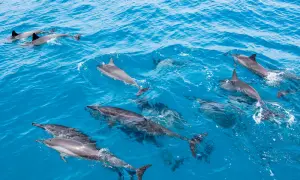
Mirror self-recognition is a laboratory finding, but the cognitive capacity it reveals shows up continuously in the behavior of wild spinner dolphins.
Every spinner dolphin develops a unique signature whistle within the first months of life, a vocalization that functions as an individual identifier. Using that whistle to announce yourself to your pod, and to call to specific individuals by name, requires that you understand yourself as a distinct entity with an identity that others can recognize. That is self-awareness in practice.
Wild dolphins also demonstrate what researchers call tactical deception, the ability to behave in ways that create false impressions in the minds of other individuals. Tactical deception requires modeling both your own perspective and the perspective of others simultaneously. It has been documented in dolphins in controlled settings and inferred from behavior in wild populations. The same layered communication system that allows dolphins to coordinate complex group behavior also creates the social environment in which self-awareness becomes useful rather than merely interesting.
Why this matters when you are watching dolphins from the boat
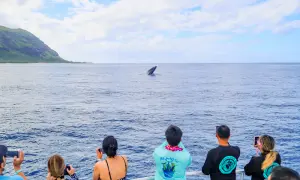
When a spinner dolphin approaches the bow of the boat off the Waianae Coast and looks up at the people watching from the rail, it is not simply registering the presence of a large object. It is an animal with a concept of self, a known identity within its pod, and the cognitive architecture to model the perspective of others.
Understanding the full picture of dolphin behavior and intelligence changes the experience of watching them entirely. The dolphin looking up at you from the bow wave knows what it looks like. It knows who it is in relation to the other animals around it. And it is, in its own way, looking back.
👉Join us on the Waianae Coast and see that intelligence operating in the wild→
Want to explore more about how Hawaii’s spinner dolphins think and behave?
👉Return to the Dolphin Behavior and Intelligence guide →
Tours depart from Waianae Boat Harbor, West Oahu, where Hawaii’s spinner dolphins gather every morning.